
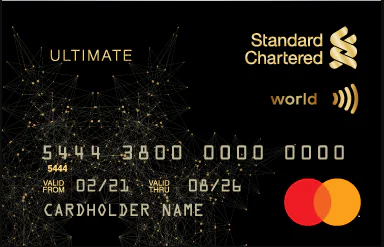
Standard Chartered Ultimate Credit Card
Standard Chartered VisaWelcome Bonus: 6000 Reward Point
Lounge Access: Yes
Fuel Surcharge: Yes
| Minimum Income | 6,00,000 |
|---|---|
| Credit Score | 700+ |
| Employment Type | Salaried Self-employed Business |
✅ 6,000 welcome bonus points (offsets first-year fee) supermarkets
✅ Lowest 2% forex markup in premium segment
❌ Reduced 2% rewards on utilities, insurance
❌ 1% processing fee on rent payments
I Ran the Numbers on This ₹5,000 Card — Here’s What Changed
Imagine spending ₹50,000 a month consistently. That’s ₹6 lakh a year across groceries, utilities, insurance premiums, shopping, and dining. With the right credit card, that translates to roughly ₹20,000 worth of rewards annually — enough to fund a decent weekend getaway or offset your card’s annual fee several times over.
The Standard Chartered Ultimate Credit Card positions itself exactly in this space. It promises a flat 3.3% reward rate across spends (5 reward points per ₹150, where each point equals ₹1). On paper, that’s competitive with premium offerings like HDFC Diners Club Black. But here’s what changed in 2026 and why it matters: several high-spend categories now earn reduced rewards, rent payments attract a processing fee, and the redemption catalogue has shrunk noticeably.
This card isn’t for entry-level users or casual spenders. It demands ₹5,000 annually — both as joining fee and renewal fee — with no waiver option. That means you need to genuinely extract value from rewards, golf privileges, and travel perks to justify the cost. If your monthly credit card spend sits below ₹40,000-50,000, or if you don’t care about golf and international lounge access, this fee will likely pinch more than it should.
Key Benefits & Features of Standard Chartered Ultimate Credit Card
Reward Structure: The Core Appeal
You earn 5 reward points for every ₹150 spent, with each point valued at ₹1. This translates to a 3.3% reward rate — genuinely competitive in the premium card segment.
Where this works well:
- Retail shopping, dining, and most everyday expenses earn the full 5 points per ₹150
- Unlike some cards that only reward transactions above ₹150, the Ultimate gives you 1 reward point even if you spend ₹50 on coffee
- No monthly cap on total reward points (earlier categories had limits, but those were removed)
Where rewards fall short: Starting April 2023, several categories now earn only 3 reward points per ₹150 (2% reward rate):
- Utilities (electricity, water, mobile recharges)
- Supermarkets
- Insurance premiums
- Property management/rent payments
- School fees
- Government payments
Exclusions: Fuel transactions earn zero reward points, though you get a 1% surcharge waiver (capped at ₹1,000 per month).
Rental payments: Not only do these earn reduced rewards (3 points per ₹150), but you’re also charged a 1% processing fee plus taxes. So if you pay ₹20,000 rent via this card, you’ll pay an extra ₹200+ in fees while earning only ₹400 in rewards. The net benefit shrinks to just ₹200, making this largely pointless for rent.
Welcome Benefit
You receive 6,000 reward points (worth ₹6,000) upon paying the joining fee. These points are credited within 60 days of fee payment. Effectively, this offsets your first-year annual fee, making the card temporarily “free” in year one.
However, renewal doesn’t come with bonus points unless you meet specific spend milestones.
Travel Benefits: Where This Card Shines
Airport Lounge Access:
- 4 complimentary domestic lounge visits per calendar quarter using the physical card (16 visits annually total)
- 1 complimentary international lounge visit per month via Priority Pass, but only if you spent ₹20,000+ in the previous calendar month
- Additional visits (including guests) are charged at Priority Pass usage fees (~USD 27 per visit)
Reality check: Most premium cards offer unlimited or higher complimentary lounge access without spending thresholds. Axis Vistara Infinite, for instance, gives 8 international visits annually without monthly spend conditions.
Duty-Free Shopping:
- 5% cashback on all duty-free purchases at airports
- Capped at ₹1,000 per month
If you’re a frequent international traveler who regularly shops at duty-free outlets, this adds up. On a ₹20,000 purchase, you save ₹1,000 instantly.
Foreign Currency Markup:
- Only 2% markup on international transactions (down from the standard 3.5%)
- This is among the lowest in India for a credit card
- On ₹1 lakh worth of forex spends annually, you save ₹1,500 compared to cards with 3.5% markup
Golf Benefits: The Headline Feature
You get access to premier golf courses across India, with complimentary rounds at select clubs. This is marketed heavily by Standard Chartered, positioning the Ultimate as a “golf credit card.”
Practical reality:
- You need to actively golf to extract value
- Redemption process involves booking through the bank’s concierge
- Availability depends on the club and time slot
- Most users report the benefit sounds better than it actually performs
If you’re genuinely into golf and play 8-10 rounds annually, the value adds up (₹20,000+ in saved green fees). For everyone else, this is a feature you’ll likely ignore.
Insurance Coverage
Air Accident Insurance: ₹1 crore cover (₹10 million) in case of accidental death during air travel
Travel Insurance:
- Emergency medical expenses: Up to USD 25,000
- Baggage delay: USD 100 (max USD 10 per 8 hours, after 12-hour delay)
- Loss of baggage: USD 750 (single item limit: USD 30)
- Flight delay: USD 200 (max USD 10 per hour, after 12-hour delay)
- Hijacking: USD 100 (USD 75 per 6 consecutive hours, after 24-hour period)
Who benefits: Frequent flyers who travel internationally multiple times a year. If you rarely fly or mostly travel domestically, these benefits remain dormant.
Redemption Options: The Growing Problem
Reward points can be redeemed via the 360° Rewards portal for:
- Shopping vouchers (Nykaa, Croma, Shoppers Stop, etc.)
- Merchandise
- Charity donations
The catch:
- ₹99 redemption fee applies every time you redeem
- Redemption options have shrunk significantly — no more Amazon Pay vouchers, limited jewelry/gold options
- Reward points expire 3 years from accumulation
- You cannot transfer points to airline miles or use them for flight/hotel bookings directly
Practical tip: To minimize the ₹99 fee impact, redeem in bulk rather than small amounts. If you’re redeeming 5,000 points, the ₹99 fee is negligible (2% impact). But if you redeem 500 points, the fee eats 20% of the value.
Charges, Fees & Hidden Costs
| Fee Type | Amount |
|---|---|
| Joining Fee | ₹5,000 + GST (₹5,900 total) |
| Annual Renewal Fee | ₹5,000 + GST (₹5,900 total) |
| Fee Waiver Conditions | None (no spend-based waiver) |
| Interest Rate (APR) | 3.75% per month (45% p.a.) |
| Late Payment Fee | ₹500 (₹501-₹5,000 outstanding) <br> ₹700 (₹5,001-₹10,000) <br> ₹900 (₹10,001-₹25,000) <br> ₹1,200 (above ₹25,000) |
| Foreign Currency Markup | 2% (lower than standard 3.5%) |
| Cash Withdrawal Fee | 3% of amount, minimum ₹300 |
| Fuel Surcharge Waiver | 1% (capped at ₹1,000/month) |
| Rent Payment Processing | 1% + GST |
| Reward Redemption Fee | ₹99 per transaction |
Are These Fees Justified?
₹5,900 annually is steep, especially with no waiver option. To genuinely justify this cost through rewards alone, you’d need to spend approximately ₹1.8 lakh annually (₹15,000/month) even at the full 3.3% rate.
But factor in reduced rewards on utilities, insurance, and supermarkets (which make up a significant chunk of most people’s monthly spend), and the breakeven threshold climbs higher — closer to ₹2.5-3 lakh annually.
The 2% forex markup is excellent if you travel internationally. The ₹99 redemption fee feels petty for a premium card, especially when you’re already paying ₹5,900 annually.
Bottom line: The fees are justifiable only if you genuinely use travel benefits (lounges, duty-free cashback), golf privileges, and spend heavily across unrestricted categories.
Eligibility & Approval Reality
Official Criteria
- Age: 21 to 65 years
- Occupation: Salaried, self-employed, or business person
- Income: Not publicly disclosed, but this is positioned as a high-income card
Approval Reality
Standard Chartered doesn’t advertise exact income requirements, but based on user reports and banking norms:
Salaried individuals: Minimum annual income of ₹8-10 lakh (some approvals reported at ₹6 lakh with good credit history)
Self-employed/business owners: ITR showing annual income above ₹10 lakh preferred
Credit score: A score of 750+ significantly improves approval odds. Below 700, rejections are common.
Existing Standard Chartered relationship: If you already hold a savings account or another credit card with Standard Chartered, approval becomes easier. The bank often offers upgrades or instant approvals to existing customers with good standing.
Documents Required
For Salaried:
- PAN card (mandatory)
- Aadhaar/Passport/Voter ID/Driving License (identity + address proof)
- Latest salary slip
- Last 3-6 months’ bank statements
For Self-Employed:
- PAN card (mandatory)
- Identity and address proof
- Last 2 years’ ITR with computation of income
- Business continuity proof (GST registration, trade license, etc.)
- Last 6 months’ bank statements
Application Tips
- Apply only if you meet the income profile: This isn’t an entry-level card. Applying without adequate income increases rejection risk and impacts your credit score.
- Clean credit history matters: Late payments or high credit utilization on existing cards reduce approval chances.
- Leverage existing relationship: If you’re a Priority Banking or Premium Banking customer with Standard Chartered, you’ll likely get faster approval and better credit limits.
Limitations & Drawbacks (No Sugarcoating)
1. Reduced Rewards on Key Categories
The April 2023 devaluation hit hard. Categories like utilities, supermarkets, insurance, and school fees now earn only 2% instead of 3.3%. For a family spending ₹30,000 monthly across these categories, that’s ₹360 lost in potential rewards every month (₹4,320 annually).
2. Rent Payments Became Expensive
With a 1% processing fee plus reduced rewards, paying rent via this card now feels like a trap. You’re better off using UPI or direct bank transfer.
3. Shrinking Redemption Options
Users consistently complain that the 360° Rewards portal has become restrictive:
- No Amazon Pay vouchers
- Limited gold/jewelry gift vouchers
- Popular airline redemptions (like Vistara) removed
- The catalogue keeps shrinking, locking users into whatever remains
This makes accumulated points feel less valuable over time.
4. No Annual Fee Waiver
Unlike cards like HDFC Regalia or Axis Reserve, there’s no option to waive the ₹5,900 annual fee by hitting spend milestones. Once you hold this card, you’re paying the fee every year — no exceptions.
5. Lounge Access Conditions
The international lounge benefit requires ₹20,000 monthly spend. If you don’t hit that threshold in a month, you lose that month’s complimentary visit. This feels unnecessarily restrictive for a card charging ₹5,900 annually.
6. ₹99 Redemption Fee Feels Petty
Charging a redemption fee on a premium card that already costs ₹5,900/year seems excessive. It discourages small redemptions and adds friction to the user experience.
7. Who Should Avoid This Card
- Monthly spenders below ₹40,000
- People who don’t travel internationally
- Non-golfers
- Users looking for straightforward cashback instead of points-based rewards
- Anyone uncomfortable with restricted redemption catalogues
Comparison With Similar Cards
| Feature | SC Ultimate | HDFC Diners Club Black | Axis Vistara Infinite |
|---|---|---|---|
| Annual Fee | ₹5,900 (no waiver) | ₹10,000 (waivable on ₹5L spend) | ₹10,000 (waivable on ₹4L spend) |
| Reward Rate | 3.3% (general)<br>2% (utilities, insurance, etc.) | 3.3% (general) | 1.5% (general)<br>3% (airline bookings) |
| Forex Markup | 2% | 3.5% + 1% reward (net 2.5%) | 3.5% |
| Domestic Lounge | 16 visits/year (4 per quarter) | Unlimited | Unlimited |
| International Lounge | 12 visits/year (spend condition) | 8 visits/year (no condition) | 8 visits/year (no condition) |
| Welcome Benefit | 6,000 points | 10,000 points | 10,000 CV Points + lounge vouchers |
| Redemption | Vouchers only (₹99 fee) | Flights, hotels, vouchers (no fee) | Flights, hotels (Vistara focus) |
| Best For | Forex spends + golf | Travel + dining | Vistara frequent flyers |
Where Ultimate Wins:
- Lowest forex markup (2%) among the three
- Golf benefits (if you actually golf)
- Lower annual fee (₹5,900 vs ₹10,000)
Where It Loses:
- No annual fee waiver option
- Reduced rewards on common categories
- Inferior lounge access (both quantity and conditions)
- Limited redemption flexibility
- ₹99 redemption fee
Verdict: If forex savings and golf matter to you, Ultimate competes. For general rewards and travel, HDFC Diners Club Black or Axis Vistara Infinite offer better overall value.
Pros & Cons of Standard Chartered Ultimate Credit Card
| Pros | Cons |
|---|---|
| ✅ 3.3% reward rate on most spends | ❌ ₹5,900 annual fee with no waiver option |
| ✅ 6,000 welcome bonus points (offsets first-year fee) | ❌ Reduced 2% rewards on utilities, insurance, supermarkets |
| ✅ Lowest 2% forex markup in premium segment | ❌ 1% processing fee on rent payments |
| ✅ 5% cashback on duty-free shopping | ❌ ₹99 charged every time you redeem rewards |
| ✅ Complimentary golf access at premier courses | ❌ International lounge requires ₹20,000 monthly spend |
| ✅ 16 domestic lounge visits annually | ❌ Shrinking redemption catalogue (no Amazon, Vistara) |
| ✅ Travel insurance up to USD 25,000 | ❌ Reward points expire in 3 years |
| ✅ Air accident cover of ₹1 crore | ❌ Fuel earns zero rewards (only 1% surcharge waiver) |
Overall Assessment
Who Gets Maximum Value
The Standard Chartered Ultimate makes sense for a narrow user profile:
The ideal cardholder:
- Spends ₹50,000+ monthly across unrestricted categories
- Travels internationally 4-6 times a year (to utilize forex savings and lounge access)
- Actually plays golf and will use the complimentary rounds
- Doesn’t mind points-based rewards instead of cashback
- Can stomach the ₹99 redemption fee and limited voucher options
If you check these boxes, the card delivers decent value — especially if you maximize forex savings (2% vs 3.5% adds up on international trips) and golf benefits.
Where It Underperforms
For most people, the April 2023 devaluation significantly diminished this card’s appeal:
- Utilities, insurance, supermarkets — everyday high-spend categories — now earn only 2%
- Rent payments became loss-making due to the 1% processing fee
- No fee waiver means you’re locked into paying ₹5,900 every year
- Redemption restrictions make accumulated points feel less flexible
If you’re a typical salaried professional spending ₹40,000-60,000 monthly across mixed categories, cards like SBI Cashback (5% on online), HDFC Millennia (cashback + decent rewards), or even Axis Ace (5% on bill payments) will likely serve you better at a fraction of the annual cost.
Long-Term Usability
The elephant in the room: Standard Chartered’s tendency to devalue cards over time. Users who held this card pre-2023 saw a significant reduction in value overnight. The redemption catalogue keeps shrinking. There’s no guarantee future devaluations won’t erode benefits further.
Unless you’re genuinely extracting ₹10,000+ in annual value (via golf, forex savings, and maximized rewards), the long-term ROI feels uncertain.
Decide Factor: Should You Apply?
✅ Best For
- Frequent international travelers who will save via 2% forex markup and duty-free cashback
- Active golfers who play at premium courses 8-10 times annually
- High spenders consistently charging ₹50,000+ monthly on retail, dining, and shopping (not utilities/insurance)
- Standard Chartered Priority/Premium Banking customers who want a consolidated relationship
- Users who value exclusive perks (concierge, golf, travel insurance) over pure cashback
❌ Avoid If
- Your monthly credit card spend is below ₹40,000
- You rarely travel internationally
- You don’t golf and won’t use that benefit
- You want straightforward cashback, not points-based rewards
- You dislike restrictive redemption catalogues
- You spend heavily on utilities, insurance, supermarkets (now only 2% rewards)
- You’re unwilling to pay ₹5,900 annually with no waiver option
💡 Works Best When Used Like This
Strategy 1: Dedicated International Travel Card Use this exclusively for forex spends and international trips. The 2% markup saves you ₹1,500 on every ₹1 lakh spent abroad. Combine that with duty-free cashback and lounge access, and the ₹5,900 fee pays for itself on 2-3 international trips annually.
Strategy 2: Golf + Retail Combo If you genuinely golf, extract ₹15,000-20,000 in green fee savings annually. Use the card for retail shopping and dining (full 3.3% rewards). Avoid using it for utilities, rent, insurance, or fuel.
Strategy 3: Supplement to a Cashback Card Hold a zero-fee cashback card (SBI Cashback, Axis Ace) for utilities, online shopping, and bill payments. Use the Ultimate only for categories where it truly excels: international spends, duty-free shopping, golf, and high-value retail.
How to Apply (Step-by-Step)
Online Application
Step 1: Visit the official Standard Chartered website at https://www.sc.com/in/credit-cards/ultimate-card/
Step 2: Scroll down and click “Apply Now” or call customer care (1800-345-1000 or 1860-500-5555)
Note: Standard Chartered doesn’t offer instant online application completion for the Ultimate card. Most applications require branch visits or relationship manager interactions.
Step 3: If you’re an existing customer, log into your net banking or SC Mobile app to check for pre-approved offers. This route often provides faster approval.
Documents Required
Gather these before applying:
Identity Proof:
- PAN card (mandatory)
- Aadhaar/Passport/Voter ID/Driving License
Address Proof:
- Any of the above with current residential address
Income Proof (Salaried):
- Latest salary slip (last 1-3 months)
- Last 3-6 months’ bank statements
Income Proof (Self-Employed):
- Last 2 years’ ITR with computation
- Business proof (GST, trade license, shop establishment certificate)
- Last 6 months’ bank statements
Photograph:
- 1 recent passport-sized photo
Typical Approval Timeline
- Existing customers with pre-approved offers: 3-5 working days
- New applicants: 7-14 working days (includes credit check and document verification)
- Card delivery: 7-10 working days post-approval
- Total timeline: Expect 2-3 weeks from application to card receipt
Activation: Done via SMS, net banking, or SC Mobile app immediately upon receiving the card.
FAQs
1. Is this card lifetime free?
No. The Standard Chartered Ultimate has a ₹5,000 + GST (₹5,900 total) joining fee and an identical annual renewal fee every year. There’s no spend-based waiver.
2. Are reward points worth it?
Debatable. At face value, 1 reward point = ₹1, giving a 3.3% rate on most spends. But reduced rewards on utilities/insurance (2%) and the ₹99 redemption fee diminish real-world value. Additionally, the shrinking redemption catalogue (no Amazon Pay, limited options) makes points feel less flexible than cashback.
3. What are the lounge access conditions?
- Domestic: 4 complimentary visits per calendar quarter (16 annually) using your physical card
- International: 1 complimentary visit per month via Priority Pass, only if you spent ₹20,000+ in the previous calendar month
- Additional visits are charged at Priority Pass fees (~USD 27 per use)
4. What happens to fees after the first year?
You’ll be charged ₹5,900 (₹5,000 + GST) as renewal fee every year. Unlike some premium cards, there’s no option to waive this by hitting spend targets. It’s a guaranteed annual cost.
5. Is this suitable for credit card beginners?
No. The ₹5,900 annual fee and high-income eligibility make this unsuitable for first-time cardholders. Beginners should look at lifetime-free or low-fee cards (Axis Ace, SBI SimplyCLICK, HDFC Millennia) to build credit history before considering premium cards.
6. Can I use reward points for flight bookings?
No. Unlike HDFC or Axis cards that let you redeem points for flights/hotels directly, Standard Chartered restricts redemptions to shopping vouchers and merchandise via the 360° Rewards portal. You cannot transfer points to airline miles.
7. How does the 2% forex markup work?
When you make international purchases or ATM withdrawals in foreign currency, you’re charged a 2% markup over the exchange rate (plus GST on the markup). Most cards charge 3.5%, so you save 1.5% on every forex transaction.
8. Is the golf benefit really valuable?
Only if you actively golf. The complimentary rounds at premier courses can save ₹2,000-5,000 per visit. If you play 8-10 times annually, that’s ₹20,000-40,000 in value. But if you don’t golf, this benefit is completely wasted.
9. Why is there a ₹99 redemption fee?
Standard Chartered charges ₹99 + GST every time you redeem reward points. The bank claims this covers processing costs, but users find it unreasonable on a card that already costs ₹5,900/year. To minimize impact, redeem larger amounts at once (e.g., 10,000 points instead of 1,000).
10. How does this compare to HDFC Diners Club Black?
Both offer 3.3% rewards, but HDFC DCB wins on:
- Better redemption (flights, hotels, vouchers with no fee)
- Unlimited domestic lounge access
- Fee waiver option (₹5L annual spend)
SC Ultimate wins on:
- Lower forex markup (2% vs effective 2.5%)
- Golf benefits (if you use them)
- Lower annual fee (₹5,900 vs ₹10,000)
Choose based on whether forex savings + golf matter more than redemption flexibility and lounge access.
Final Verdict
The Standard Chartered Ultimate Credit Card is stuck in an awkward position.
It’s too expensive to justify for casual users. The ₹5,900 annual fee with zero waiver options means you must actively extract value — and for most people, the April 2023 devaluation made that harder. Reduced rewards on utilities, insurance, and supermarkets, combined with the punitive 1% rent processing fee, cut into the card’s everyday usability.
Yet it’s not premium enough to compete with true super-premium cards like HDFC Diners Club Black or Axis Reserve, which offer better lounge access, more redemption flexibility, and fee waivers.
Who should still consider it? If you travel internationally frequently (leveraging the 2% forex markup and duty-free cashback), actively golf at premium courses, and spend heavily on retail/dining, this card can deliver ₹15,000-25,000 in annual value. In that narrow scenario, the ₹5,900 fee feels justified.
For everyone else? You’re better off with zero-fee cashback cards for everyday spends (SBI Cashback, Axis Ace), supplemented by a travel-focused card if needed (Vistara co-brand, HDFC Regalia). The Ultimate demands too much investment for what it now delivers.
Final score: 6.5/10 — Niche appeal for a specific user profile, but no longer a must-have in India’s increasingly competitive premium card space.
Other Credit Cards to Consider In This Range
American Express Platinum Travel Credit Card
Kotak Delight Platinum Credit Card
Jupiter Edge CSB Bank RuPay Credit Card
Disclaimer: Card features, fees, and benefits are subject to change at the issuer’s discretion. Always verify details on the official Standard Chartered website before applying. Reward rates, redemption options, and promotional offers may vary based on bank policies and are not guaranteed.