How to choose a credit card when every bank in India is bombarding you with offers? Open your email, and you’ll see ads from HDFC, SBI, ICICI, Axis—everyone promising cashback, reward points, and benefits that sound too good to be true. Here’s what nobody tells you: picking the wrong credit card can quietly drain thousands of rupees from your wallet every year through fees you didn’t notice and rewards you’ll never use.
Learning how to pick a credit card isn’t about grabbing whatever has the biggest welcome bonus. It’s about finding the one card that fits your actual spending habits, saves you real money on purchases you’re already making, and doesn’t cost you a fortune in hidden charges. Think of me as your friend who works in banking, sitting with you and breaking down exactly how to decide on a credit card that makes sense for YOUR life, not some marketing team’s fantasy customer.
Whether you’re figuring out how to choose a credit card for the first time or looking to upgrade, this guide will help you find the right credit card without the confusion.
Why Learning How to Choose a Credit Card Matters in India
Let’s start with reality: the wrong credit card costs you money every single month. Not through fraud or scams, but through boring stuff like annual fees for benefits you never use, interest charges because you didn’t understand the 3% monthly rate, or reward programs that don’t match how you actually spend.
Picture this: You sign up for a premium travel card because the advertisement shows people flying business class. Sounds aspirational, right? But you only fly once a year to visit family, you’re paying ₹5,000 annual fee, and those reward points expire before you collect enough for a single ticket. Meanwhile, you’re spending ₹15,000 monthly at grocery stores and petrol pumps, getting maybe 1% back, when a simple cashback card would have given you 5% on fuel and groceries. That’s ₹7,000-8,000 per year left on the table.
India has unique credit card factors that don’t exist elsewhere. Fuel surcharge waivers can save you 1% on every petrol fill-up (that’s ₹1,000+ annually for most people). GST at 18% gets added to your annual fees, turning that ₹999 fee into ₹1,179. Many premium cards charge forex markup of 3.5% when you shop internationally or on foreign websites, eating into any rewards you earned.
The right card becomes a financial tool that works for you. It helps build your CIBIL score through consistent, on-time payments. It saves money on everyday purchases through category-specific rewards. And yes, occasionally it gets you free stuff, but the sustainable kind—airport lounge access when you actually travel, not points that expire worthless.
Your credit card choice impacts your finances for years. That card in your wallet is either helping you build credit history and saving money, or charging you fees and offering nothing valuable. The difference compounds over time.
See Also: Best Side Hustle in India: Start Earning Today (2026)
Know Your Spending Pattern Before You Pick a Credit Card
Before comparing cards, have an honest conversation with yourself. Not the version who wishes they traveled internationally every quarter, but the real you who exists right now.
Check your bank statements from the last three months. Look at where money actually goes. This is the secret: reward programs are designed for idealized customers who don’t really exist.
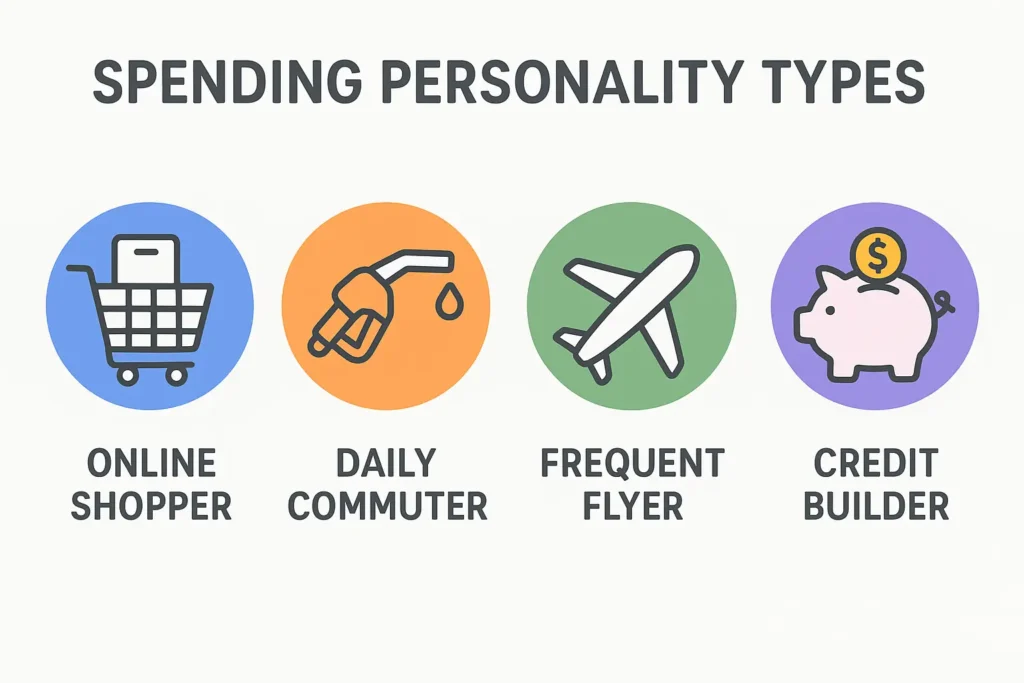
Let’s break down Indian spending personalities:
The Online Shopping Enthusiast: You order from Amazon, Flipkart, Swiggy, and Zomato regularly. You spend ₹10,000+ monthly on e-commerce and food delivery. Cards like Amazon Pay ICICI (5% cashback on Amazon) or Flipkart Axis (5% cashback on Flipkart) are perfect for you.
The Daily Commuter: Most money goes to fuel, groceries, utility bills, and occasional dining. You’re not flying to Goa every month; you’re driving to the office daily. Cards with fuel surcharge waivers and grocery rewards are your best friends. BPCL SBI Card or Indian Oil Axis cards can save you thousands annually.
The Frequent Flyer: You genuinely fly 6+ times yearly for work or leisure. You spend serious money on flights and hotels. Premium travel cards like Vistara ICICI or Intermiles HDFC might justify their annual fees. But be honest—one vacation to Manali doesn’t make you a frequent flyer.
The Credit Builder: You’re new to credit or rebuilding after missed payments. Your priority isn’t rewards; it’s proving responsibility. You need a card that reports to CIBIL without costing money to hold. Secured cards or entry-level cards like SBI SimplyCLICK work here.
Write down your top five spending categories from last month. If “groceries and fuel” dominate, don’t fool yourself into getting a card optimized for international travel. You’ll pay for unused features while missing rewards on actual purchases.
How to Choose a Credit Card: The 5 Key Factors
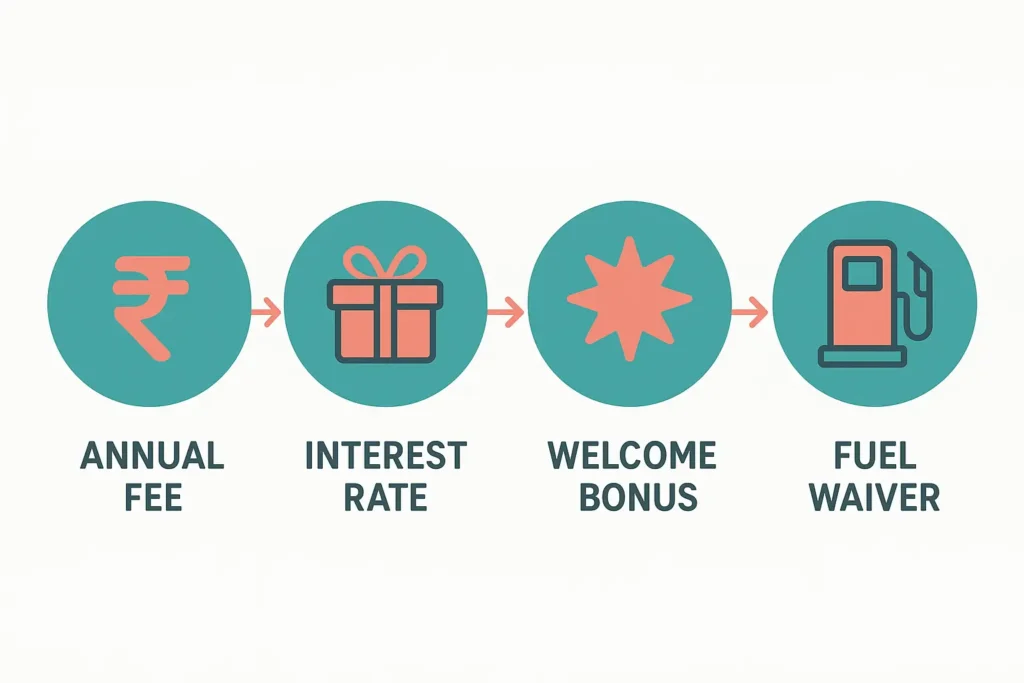
When comparing credit cards, five factors will make or break your decision. Let’s examine each one.
1. Annual Fees and Joining Fees
Many Indian cards charge joining fees (₹500-₹10,000) and annual fees (₹0-₹50,000). Premium cards like HDFC Diners Black charge ₹10,000 annually. The question isn’t whether fees are bad—it’s whether the card delivers more value than it costs.
Simple formula: Benefits minus fees = net value. If that number is positive and bigger than a free card would give, the fee might be worth it.
Example: HDFC Regalia charges ₹2,500 annual fee but offers 4 complimentary airport lounge visits (worth ₹500 each = ₹2,000), plus rewards worth ₹3,000-4,000 if you spend ₹50,000 monthly. Net positive. But if you never use lounges and spend only ₹20,000 monthly, you’re wasting ₹2,500.
Many cards waive annual fees if you spend a certain amount (say, ₹1.5 lakhs annually). Calculate if you’ll naturally hit that threshold.
Read Also: Best Earning Apps in India (2025): Zero Investment Guide
2. Interest Rates in India
Indian credit cards typically charge 3% per month on unpaid balances. That’s roughly 36-42% annually due to compounding. This is one of the highest lending rates in consumer finance.
Critical question: Will you pay in full every month? If yes, interest rates barely matter. You could have 42% interest and never pay a rupee if you clear your statement balance by the due date.
But if there’s even a 30% chance you’ll carry a balance some months, interest rates become crucial. A ₹50,000 balance carried for 6 months at 3% monthly costs you roughly ₹9,000 in interest charges. That wipes out any rewards you earned.
3. Reward Programs: Cashback vs. Points
Cashback is simplest. Spend ₹100, get ₹2-5 back depending on category. You can use it to offset your bill. Clean and transparent.
Reward points are more complex. You earn points, then redeem for products, vouchers, or travel bookings. Value per point varies wildly. One reward point might equal ₹0.20 or ₹1 depending on redemption. Banks make this confusing intentionally.
My honest take for most Indians? Cashback beats complicated points. A 5% cashback on specific categories is straightforward. “Earn 10 points per ₹150 spent, redeemable at 0.5 paisa per point on select travel partners during off-peak seasons” is designed to confuse you.
4. Welcome Bonuses and Milestone Benefits
Welcome bonuses in India typically range from ₹500-₹10,000 worth of reward points or vouchers when you spend a certain amount in the first 60-90 days. They’re valuable but shouldn’t be your only consideration.
Key question: Can you hit the spending requirement naturally? If you need to spend ₹1 lakh in 90 days and your normal spending is ₹80,000/month, perfect. If your normal spending is ₹25,000/month, you’ll either miss the bonus or buy unnecessary things. That’s not a win.
Many cards also offer milestone benefits—spend ₹5 lakhs in a year, get ₹5,000 worth of vouchers. Calculate if you’ll reach those milestones with regular spending.
5. Fuel Surcharge Waivers
This is uniquely valuable in India. Most cards offer 1% fuel surcharge waiver on transactions of ₹400-4,000 at petrol pumps. If you spend ₹5,000 monthly on fuel, that’s ₹600 saved annually. For many Indians, this single benefit justifies holding a card.
Check the terms: some cards have monthly caps (₹100-250 maximum waiver per month), transaction limits, and restrictions on which fuel companies participate.
See Also:How to Save Money Fast on a Low Income (2026 Guide)
How to Choose a Credit Card for the First Time (Beginner’s Section)
If this is your first credit card, the rules are different. Let’s talk about what actually matters when starting from zero.
Income requirements: Most Indian banks require minimum monthly income of ₹15,000-₹25,000 for regular cards. If you don’t meet this, secured cards are your option. You deposit ₹10,000-50,000 as fixed deposit, and the bank issues a card with 80-90% of that amount as credit limit.
Secured cards aren’t inferior—they build CIBIL scores identically to regular cards. Use it responsibly for 6-12 months, and banks will offer unsecured cards.
Documents you’ll need:
- PAN card (mandatory)
- Aadhaar card
- Salary slips (last 3 months) or ITR
- Bank statements (last 3-6 months)
What to prioritize for your first card:
- Zero annual fee: Don’t pay money to build credit. SBI SimplyCLICK, HDFC MoneyBack, and Axis MyZone are solid free options.
- Reports to CIBIL: Confirm the card reports to credit bureaus. Some co-branded cards don’t report properly, which means they don’t help your credit score.
- Reasonable credit limit: Start with ₹25,000-50,000. You don’t need ₹2 lakhs for your first card.
Strategy for first-timers: Start small, pay in full, be boring. Use your card for one or two regular expenses—maybe fuel and groceries. Set up autopay for the full statement amount. Do this for 6-12 months, and you’ll build solid credit foundation.
Your first card is about building trust with the financial system, not maximizing rewards. That CIBIL score will save you lakhs on home loans, car loans, and open doors to premium cards later.
Best Card Categories for Different Indians
Let me give you specific recommendations based on actual spending patterns:
For Online Shopping: If you spend ₹5,000+ monthly on Amazon, get Amazon Pay ICICI (5% unlimited cashback on Amazon, 1% elsewhere, zero annual fee). For Flipkart loyalists, Flipkart Axis offers similar benefits.
For Fuel Savings: BPCL SBI Card or Indian Oil Axis Card offer 5-7% value back on fuel plus 1% surcharge waiver. If you spend ₹5,000 monthly on petrol, these cards save ₹3,000-4,000 annually.
For Groceries and Dining: HDFC MoneyBack gives 5% cashback on Big Bazaar, Reliance Fresh, and More. SBI SimplyCLICK offers 10X rewards on dining and groceries (effectively 5% back).
For Travel: If you fly regularly, Vistara ICICI or Intermiles HDFC convert spending to air miles. Premium cards like HDFC Diners Black offer airport lounge access, which is valuable if you fly 4+ times yearly.
Red Flags: Cards to Avoid in India
Not all cards are created equal. Some are designed to extract money from you:
Excessive Hidden Charges: Some cards marketed to people with low credit scores charge joining fees of ₹1,500, annual fees of ₹999, plus monthly “processing fees.” Add 18% GST, and you’re paying ₹3,000-4,000 yearly for a card with ₹30,000 limit. That’s exploitation, not credit building.
Limited Redemption Options: Some reward programs only let you redeem points on the bank’s portal with inflated prices. You “save” ₹500 on a ₹3,000 product that costs ₹2,200 on Amazon. That’s not a deal.
Co-branded Cards with Single Merchant: Unless you’re a fanatic customer of one brand, cards that only work at one retailer are restrictive. Your spending patterns change; your card shouldn’t lock you in.
See Also:Best Work From Home Without Investment: Start Earning Today
How to Apply Smartly Without Hurting Your CIBIL Score
Hard inquiries: When you formally apply, banks check your CIBIL report. This “hard inquiry” drops your score by 5-10 points temporarily. Apply for multiple cards in one month, and it signals desperation to lenders.
Pre-approved offers: Many banks send pre-approved offers based on soft inquiries that don’t hurt your score. These have higher approval rates. Check your bank’s app—you might already be pre-approved.
Application timing: Apply when your CIBIL score is healthy (720+), income is stable, and you haven’t opened multiple accounts recently. Avoid applying just before taking a home loan or car loan, as the inquiry can temporarily lower your score.
How many cards should you have? Start with one. After 6-12 months of responsible use, consider adding a second card for specific benefits. Having 2-3 cards is optimal—enough for category rewards without complicating your finances.
Conclusion
Learning how to choose a credit card in India doesn’t have to be overwhelming. Start by understanding your actual spending patterns, prioritize benefits that match those patterns, and ignore flashy features you won’t use. Your first card should be simple and free, focused on building credit. As your financial life evolves, you can add specialized cards for specific categories.
Next step: Pull up your last three months’ bank statements today. Calculate how much you spend on fuel, groceries, and online shopping. Then use that data to find the right credit card that will actually save you money, not just look impressive in your wallet.
FAQ Section
Q: How do I choose my first credit card in India with no credit history?
A: Start with a secured credit card where you deposit ₹10,000-25,000 as FD and get a card against it, or apply for entry-level cards like SBI SimplyCLICK or HDFC MoneyBack that accept lower income requirements (₹15,000-20,000 monthly). Focus on zero annual fee cards that report to CIBIL. Use it for small purchases and pay in full monthly to build your score.
Q: What’s more important when choosing a credit card—cashback percentage or annual fee?
A: Calculate net value. A card with 5% cashback and ₹500 annual fee beats a free card with 1% cashback if you spend enough. Example: ₹5,000 monthly spending at 5% = ₹3,000 annual cashback minus ₹500 fee = ₹2,500 net benefit. Same spending at 1% on free card = ₹600 benefit. Math always wins.
Q: How many credit cards should I have in India?
A: Start with one to build credit. After 6-12 months of responsible use, consider 2-3 cards maximum—one for general spending, one for specific categories (fuel/online shopping), maybe one for travel if relevant. More cards complicate tracking and increase temptation to overspend.
Q: Should I choose a credit card based on the welcome bonus offer?
A: Welcome bonuses are nice extras, not the main reason to choose. Only pursue bonuses if you’ll hit the spending requirement naturally without changing behavior. A ₹5,000 bonus that requires spending you’d never make otherwise isn’t actually ₹5,000—it’s a marketing trap. Choose based on long-term benefits that match your regular spending.
Q: What credit card features matter most for someone who travels once or twice a year?
A: Skip premium travel cards with high annual fees. Instead, choose a card with occasional traveler benefits: zero forex markup on international transactions (saves 3.5% on foreign spends), complimentary lounge access (2-4 visits annually is enough), and travel insurance. Cards like HDFC Regalia or Axis Privilege offer these without ultra-premium fees.