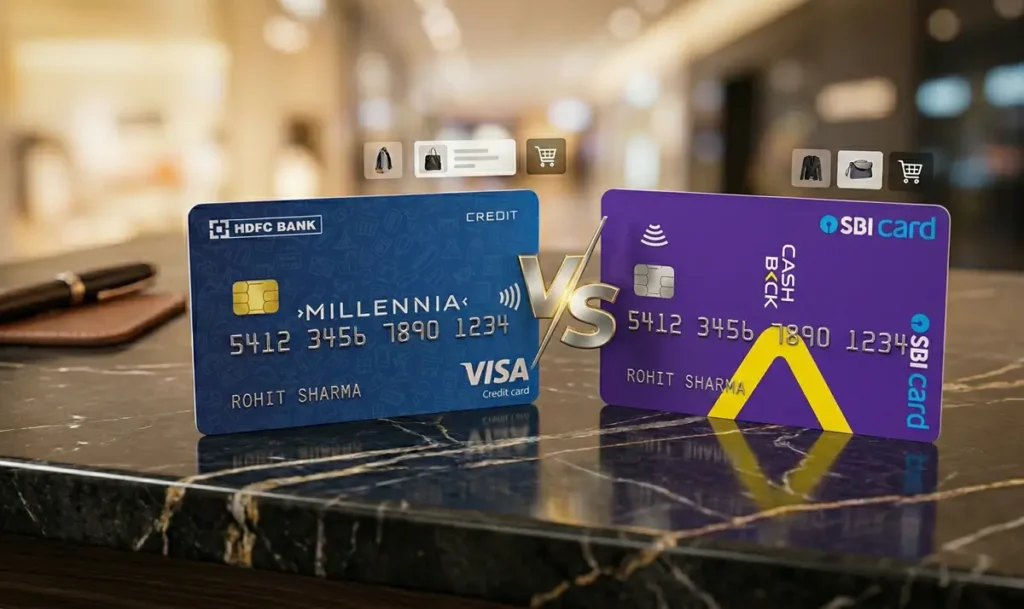
The SBI Cashback Credit Card (issued by State Bank of India on the Visa network) and the HDFC Millennia Credit Card (issued by HDFC Bank on the Visa/Mastercard network or Diners Club) are two of India’s most-discussed entry-to-mid-level credit cards in 2026. The single most important difference: the SBI Cashback Card gives a flat 5% cashback on all online transactions with no brand restrictions including amazon & flipkart, while the HDFC Millennia gives 5% cashback only on specific partner merchants you can check at smartbuy website but adds lifestyle perks like lounge access and milestone vouchers and better reward point that SBI doesn’t offer.
The SBI Cashback Credit Card is ideal for online-first shoppers who spend heavily on Amazon, Flipkart, Myntra, Meesho and other e-commerce sites. The HDFC Millennia suits lifestyle spenders who want rewards on dining, travel, and shopping across specific premium platforms.
Quick Verdict: If you spend ₹10,000/month online across any platform, the SBI Cashback Credit Card earns you ₹500/month (₹6,000/year) in direct cashback which is more than HDFC Millennia’s ₹400 on its partner platforms. But if you also dine out, travel, and shop at partner brands, HDFC Millennia’s annual net value (after fee waiver) can exceed SBI’s by ₹1,200/year. Read on to find which fits your spending.
Also Read Review of Regalia Gold vs Diners Black Which HDFC Card Wins?
Quick Comparison Table: SBI Cashback Credit Card vs HDFC Millennia Credit Card
| Feature | SBI Cashback Credit Card | HDFC Millennia Credit Card |
| Issuing Bank | State Bank of India | HDFC Bank |
| Card Network | Visa | Visa / Mastercard |
| Annual Fee | ₹999 + GST | ₹1,000 + GST |
| Joining Fee | ₹999 + GST | ₹1,000 + GST |
| Annual Fee Waiver Condition | Spend ₹2 lakh/year | Spend ₹1 lakh/year |
| Welcome / Joining Bonus | None (as per current terms) | ₹1,000 worth of gift vouchers on fee payment |
| Reward Rate — Partner Platform | 5% cashback (all online) | 5% cashback (select partners: Amazon, Flipkart, etc.) |
| Reward Rate — Online (general) | 5% on all online transactions | 1% on non-partner online spends |
| Reward Rate — Offline / POS | 1% cashback | 1% cashback (as CashPoints) |
| Reward Rate — Dining | 1% offline; 5% if paid online via Swiggy/Zomato | 5% on Swiggy & Zomato (partner); 1% at restaurants offline |
| Reward Rate — Travel / Flights | 1% offline; 5% if booked online | 5% on MakeMyTrip, GoIbibo (partner); 1% others |
| Reward Rate — Fuel | 1% (plus 1% surcharge waiver) | 1% CashPoints + 1% surcharge waiver |
| Reward Rate — Utilities / Bills | 5% online (via apps like BBPS); 1% offline | 1% CashPoints |
| Monthly Reward Cap | ₹5,000 total cashback/month | ₹1,000 CashPoints/month on 5% categories |
| Reward Type | Direct cashback (auto-credited) | CashPoints (must be redeemed) |
| Reward Redemption Method | Auto-credited to statement | Net banking / app redemption against statement |
| Reward Points Expiry | No expiry (cashback) | 2 years from earn date |
| Lounge Access — Domestic | None | 8 complimentary visits/year (via Dreamfolks) |
| Lounge Access — International | None | None (standard card) |
| Fuel Surcharge Waiver | 1% waiver (₹500–₹3,000 txn, max ₹100/month) | 1% waiver (₹400–₹5,000 txn, max ₹250/month) |
| Forex Markup Fee | 3.5% | 3.5% |
| Interest Rate (APR monthly) | 3.50% per month (42% p.a.) | 3.75% per month (45% p.a.) |
| Min Income — Salaried | ₹3 LPA (approx.) | ₹3.6 LPA (approx. ₹30,000/month) |
| Min Income — Self-Employed | ₹4 LPA (approx.) | ₹4 LPA (approx.) |
| Minimum Age | 18 years | 21 years |
| Credit Score Recommended | 700+ | 700+ |
| UPI Payment Support | No (not on RuPay) | No (not on RuPay) |
| Contactless Payment | Yes (Visa payWave) | Yes (Visa payWave / Mastercard contactless) |
| Overall Rating (out of 5) | 4.3 / 5 | 4.1 / 5 |
At a glance, the SBI Cashback Credit Card wins on raw cashback value for heavy online shoppers, while HDFC Millennia edges ahead on lifestyle perks lounge access and vouchers. The SBI card’s 5% across ALL online spends (vs HDFC’s 5% only on select partners) is the decisive advantage for most Indian consumers, making SBI the better everyday card.
See Also: Amazon Pay ICICI Credit Card vs Flipkart Axis Bank Credit Card
Credit Card 1 Deep Dive: SBI Cashback Credit Card
4A. Overview
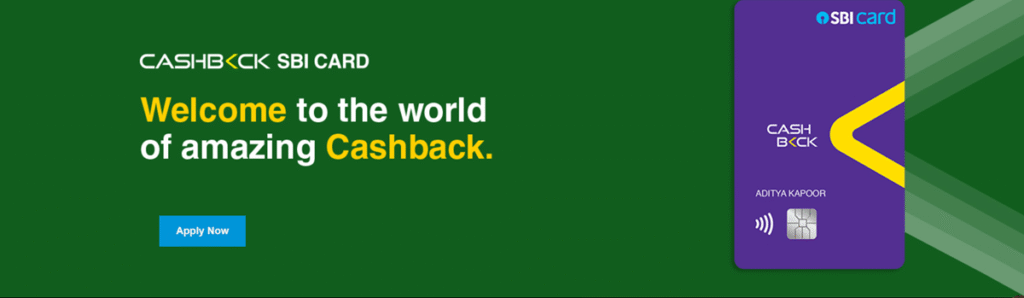
The SBI Cashback Credit Card is a cashback-focused credit card from State Bank of India, targeting online shoppers who want simple, no-fuss rewards. Its core value proposition: a flat 5% cashback on all online transactions — not restricted to any brand — automatically credited to your account with zero redemption hassle.
4B. Rewards & Benefits in Detail
Primary Reward Rate: 5% cashback on all online transactions (any website, any app)
Secondary Reward Rate: 1% cashback on all offline / POS transactions
Category Breakdown:
- Online Shopping (Amazon, Flipkart, Meesho, Myntra, Ajio, any website): 5% cashback
- Food Delivery via app (Swiggy, Zomato app orders — counted as online): 5% cashback
- Utility Bill Payment via apps/websites (BBPS, Paytm, PhonePe): 5% cashback
- Offline Grocery, Restaurant, Petrol Pump (POS swipe): 1% cashback
- Fuel: 1% cashback + 1% surcharge waiver on transactions of ₹500–₹3,000 (max ₹100/month waiver)
- EMI transactions: 0% cashback (excluded)
- Rent payments, Wallet loads, Jewellery: 0% cashback (excluded categories)
Monthly Cashback Cap: ₹5,000/month total. Once you earn ₹5,000 in a calendar month, additional spend earns 0% until next month.
Welcome Bonus: None currently. SBI does not offer a joining bonus on this card as per current terms (verify with SBI before applying).
Cashback Credit: Auto-credited to your statement every month — no redemption steps needed. Minimum balance required for credit: ₹1 cashback (no threshold).
Expiry: Cashback does not expire — it is credited as a statement balance.
4C. All Fees & Charges — SBI Cashback Credit Card
| Fee Type | Amount |
| Annual Fee | ₹999 + GST (approx. ₹1,178) |
| Joining Fee | ₹999 + GST |
| Annual Fee Waiver | Waived if total annual spend ≥ ₹2,00,000 |
| Interest Rate (monthly) | 3.50% per month |
| Interest Rate (annual) | 42% per annum |
| Late Payment Fee | ₹0–₹1,300 depending on outstanding balance |
| Cash Advance Fee | 2.5% of amount or ₹500, whichever is higher |
| Forex Markup Fee | 3.5% of transaction amount |
| Over-Limit Fee | 2.5% of over-limit amount (min ₹600) |
| Duplicate Statement Fee | ₹100 per statement |
4D. Eligibility Requirements — SBI Cashback Credit Card
- Minimum Age: 18 years (primary cardholder)
- Minimum Income (Salaried): ₹3 LPA approximately (₹25,000/month) — confirm with SBI
- Minimum Income (Self-Employed): ₹4 LPA (ITR for 1–2 years required)
- Employment Types: Salaried, self-employed, business owners
- Minimum Credit Score Recommended: 700+ (CIBIL)
- Documents Required: PAN card, Aadhaar, salary slips / bank statements (3 months), ITR for self-employed
4E. Key Perks & Features — SBI Cashback Credit Card
- Airport Lounge Access: None (this card does not include lounge access)
- Fuel Surcharge Waiver: 1% waiver at all fuel stations on transactions of ₹500 to ₹3,000; maximum waiver of ₹100 per month
- Insurance: Accidental death insurance cover of ₹2 lakh (as per current SBI terms — verify at time of application)
- EMI Facility: Flexipay EMI available on purchases above ₹2,500 — convert to EMI post-purchase via SBI net banking
- Contactless Payments: Yes — Visa payWave enabled for tap-to-pay at NFC terminals
- No Foreign Transaction Benefit: 3.5% forex markup applies — not recommended for international use
- Add-on Cards: Available for family members aged 18+
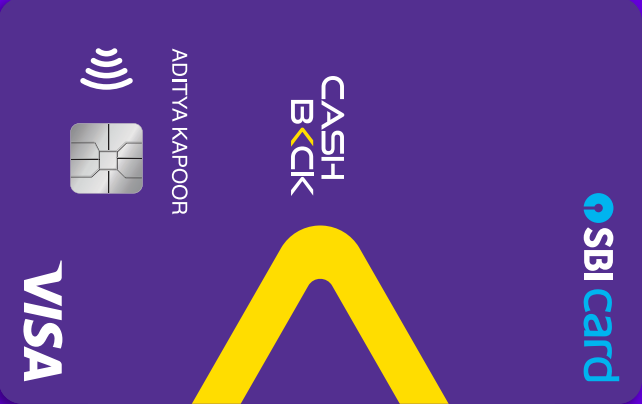
SBI Cashback Credit Card
- 5% cashback on online spends across most platforms
- 1% cashback on offline purchases
- cashback is auto-credited.
Card 2 Deep Dive: HDFC Millennia Credit Card
5A. Overview
The HDFC Millennia Credit Card is a lifestyle-focused rewards card from HDFC Bank, designed for urban millennials who shop, dine, and travel across a curated set of partner brands. Its core value proposition: 5% cashback on major e-commerce and lifestyle partners, plus domestic airport lounge access and annual milestone vouchers — all wrapped in a ₹1,000 annual fee with a low waiver threshold.
5B. Rewards & Benefits in Detail
Primary Reward Rate: 5% cashback (as CashPoints) on partner platforms: Amazon, Flipkart, BookMyShow, Cult.fit, Myntra, Sony LIV, Swiggy, Tata CLiQ, Uber, and Zomato
Secondary Reward Rate: 1% CashPoints on all other transactions (online and offline)
Category Breakdown:
- Partner E-commerce (Amazon, Flipkart, Myntra, Tata CLiQ): 5% CashPoints
- Partner Dining & Delivery (Swiggy, Zomato): 5% CashPoints
- Partner Travel (Uber): 5% CashPoints
- Partner Entertainment (BookMyShow, Sony LIV): 5% CashPoints
- Partner Fitness (Cult.fit): 5% CashPoints
- All Other Online & Offline Spends: 1% CashPoints
- Fuel, EMI, Cash Advance, Wallet Loads, Rent: 0% (excluded)
Monthly Cap: ₹1,000 CashPoints/month on all 5% partner transactions combined. After this cap, spending at partners earns 1%.
Welcome Bonus: ₹1,000 worth of gift vouchers credited on joining fee payment. Voucher partners include Amazon, Myntra, and others (subject to current HDFC offer terms).
Milestone Bonus: ₹1,000 gift voucher on spending ₹1 lakh in each half-year (₹2,000 total per year if both milestones are hit).
CashPoints Value: 1 CashPoint = ₹0.15 when redeemed against statement (thus 5% earn = 0.75% effective if redeemed at base rate). For better value, redeem via HDFC SmartBuy portal where 1 CashPoint can = ₹1 for select products.
Redemption: Log into HDFC Net Banking > Credit Cards > Redeem CashPoints > Select Statement Credit or SmartBuy. Minimum redemption: 500 CashPoints.
Expiry: CashPoints expire 2 years from the date of earning.
Check Other Cashback Credit Cards
5C. All Fees & Charges — HDFC Millennia Credit Card
| Fee Type | Amount |
| Annual Fee | ₹1,000 + GST (approx. ₹1,180) |
| Joining Fee | ₹1,000 + GST |
| Annual Fee Waiver | Waived if total annual spend ≥ ₹1,00,000 |
| Interest Rate (monthly) | 3.75% per month |
| Interest Rate (annual) | 45% per annum |
| Late Payment Fee | Up to ₹1,300 depending on outstanding balance |
| Cash Advance Fee | 2.5% of amount or ₹500, whichever is higher |
| Forex Markup Fee | 3.5% of transaction amount |
| Over-Limit Fee | 2.5% of over-limit amount (min ₹550) |
| Duplicate Statement Fee | ₹100 per statement |
5D. Eligibility Requirements — HDFC Millennia Credit Card
- Minimum Age: 21 years (primary cardholder)
- Minimum Income (Salaried): ₹3.6 LPA (₹30,000/month net) — as per HDFC’s standard criteria
- Minimum Income (Self-Employed): ₹4 LPA (ITR proof required)
- Employment Types: Salaried, self-employed, business owners, NRIs (with Indian income)
- Minimum Credit Score Recommended: 700+ (CIBIL)
- Documents Required: PAN card, Aadhaar, latest 3-month salary slips, bank statements, and Form 16
5E. Key Perks & Features — HDFC Millennia Credit Card
- Airport Lounge Access: 8 complimentary domestic airport lounge visits per year (2 per quarter) via Dreamfolks network — covers major airports including BOM, DEL, BLR, HYD, MAA, CCU
- Fuel Surcharge Waiver: 1% waiver on fuel transactions between ₹400 and ₹5,000; maximum waiver of ₹250 per month
- Insurance: Personal accident cover and lost card liability cover (verify exact amounts with HDFC at time of application)
- Milestone Vouchers: ₹1,000 gift voucher on hitting ₹1 lakh spend in each half-year period (Jul–Dec and Jan–Jun)
- EMI Facility: No-cost EMI available with select HDFC partner merchants; also available via HDFC FlexiPay
- Contactless Payments: Yes — Visa payWave / Mastercard contactless NFC payments enabled
- SmartBuy Rewards: Extra CashPoints on bookings via HDFC SmartBuy portal for flights, hotels, and shopping
- Add-on Cards: Available for family members aged 18+.
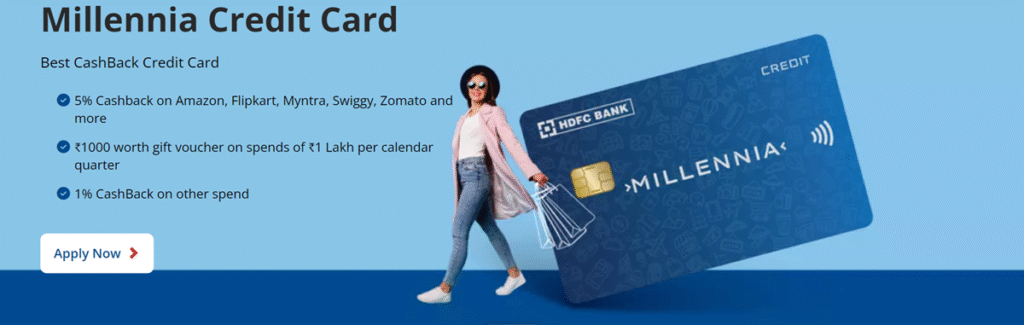
HDFC Millennia Card
- 5% Cashback on Amazon, Flipkart, Myntra, Swiggy, Zomato and more
- ₹1000 worth gift voucher on spends of ₹1 Lakh per calendar quarter
- 1% CashBack on other spend
Head-to-Head Comparisons
Which card gives more cashback on online shopping?
The SBI Cashback Credit Card wins clearly for unrestricted online shopping. It gives 5% cashback on ALL online transactions — Amazon, Flipkart, Meesho, Myntra, Ajio, Nykaa, any website or app — with a monthly cap of ₹5,000 cashback. The HDFC Millennia also offers 5%, but only on its select partner list (Amazon, Flipkart, Myntra, Tata CLiQ) with a much lower cap of ₹1,000 CashPoints per month on 5% categories. If you spend outside HDFC’s partner list — Meesho, Nykaa, Ajio, any smaller D2C brand — you earn just 1%.
₹ Example: If you spend ₹10,000/month online — ₹5,000 on Amazon and ₹5,000 on Meesho — the SBI Cashback Card earns ₹500 (5% on both). HDFC Millennia earns ₹250 on Amazon + ₹50 on Meesho (1%) = ₹300 total. SBI wins by ₹200/month on this profile.
Which card is better for dining and food delivery?
It’s a near-tie for Swiggy and Zomato app orders — both cards give 5% (SBI as cashback since app orders are ‘online’, HDFC as CashPoints on its partner list). The key difference is the cap: SBI’s ₹5,000 monthly cap is shared across all online categories, so heavy users may not be capped on dining alone. HDFC’s ₹1,000/month 5% cap covers ALL partner spends combined, so if you spend ₹5,000+ on Amazon, the dining 5% may also get capped.
For offline restaurant dining (POS swipe), both cards give just 1% — so neither card is exceptional for sit-down dining without a separate dining card.
₹ Example: Spending ₹2,500/month on Swiggy/Zomato earns ₹125 with SBI Cashback Card vs ₹125 in CashPoints with HDFC Millennia. Result: Dead heat for food delivery apps.
Which card is better for travel?
HDFC Millennia wins on travel perks. It provides 8 free domestic airport lounge visits per year (2 per quarter via Dreamfolks) — worth approximately ₹3,200 in access value (at ₹400/visit). The SBI Cashback Card offers zero lounge access.
For flight bookings: SBI gives 5% cashback on any online booking site (MakeMyTrip, Ixigo, EaseMyTrip, Goibibo). HDFC Millennia gives 5% only via MakeMyTrip and Goibibo (partner), and 1% on others.
For international travel, both cards are equally poor — 3.5% forex markup each.
Domestic Traveller: HDFC Millennia wins — lounge access is a real, tangible benefit.
International Traveller: Neither card is suitable. Consider Axis Atlas or HDFC Regalia for forex-friendly travel.
Which card has lower overall cost?
HDFC Millennia is cheaper to maintain. Its annual fee waiver kicks in at just ₹1 lakh/year spend — that’s ₹8,333/month, easily met by average Indian cardholders. SBI Cashback requires ₹2 lakh/year (₹16,667/month) — a higher bar.
| Scenario | SBI Cashback Credit Card | HDFC Millennia Credit Card |
| Year 1 cost (fee + GST) | ₹1,178 | ₹1,180 |
| Year 2+ (waiver met) | ₹0 | ₹0 |
| Year 2+ (waiver NOT met) | ₹1,178/year | ₹1,180/year |
| Waiver Spend Requirement | ₹2,00,000/year | ₹1,00,000/year |
Winner on cost: HDFC Millennia — easier fee waiver condition for moderate spenders.
Which card is easier to get approved for?
Both cards have similar credit score requirements (700+ CIBIL) and comparable income thresholds. However, SBI Cashback has a slightly lower minimum income requirement for salaried applicants (₹3 LPA vs HDFC’s ₹3.6 LPA). SBI also allows applicants from age 18, while HDFC Millennia requires 21+.
In practice, SBI may be more accessible for younger applicants or those with slightly lower incomes. HDFC is generally known for stricter underwriting but also processes applications faster through its extensive digital onboarding.
Winner on accessibility: SBI Cashback Credit Card — lower income requirement and lower minimum age.
Which card is better for fuel spends?
HDFC Millennia has a more flexible fuel surcharge waiver — it applies to transactions between ₹400 and ₹5,000, with a monthly cap of ₹250 (vs SBI’s ₹100 cap). For someone spending ₹3,000/month on fuel, HDFC saves ₹30 in surcharge waiver vs SBI’s ₹30 — identical at this spend level. But for higher fuel spends (₹5,000+/month), HDFC’s ₹250 cap gives more savings.
₹ Example: At ₹3,000/month fuel spend: both cards save ₹30 (1% waiver). At ₹5,000/month: HDFC saves ₹50 (capped at ₹250/month), SBI saves ₹50 (capped at ₹100). At ₹10,000/month: HDFC saves up to ₹100, SBI saves ₹100. Result: HDFC Millennia wins for high-fuel spenders (₹5,000+/month).
Which card offers better welcome / joining benefits?
HDFC Millennia wins this round. It gives ₹1,000 worth of gift vouchers on payment of the joining fee — effectively making Year 1 cost near zero. SBI Cashback currently offers no welcome or joining bonus.
HDFC also offers up to ₹2,000 in annual milestone vouchers (₹1,000 each for hitting ₹1 lakh spend in each half-year). SBI offers no milestone bonuses.
₹ Breakeven: HDFC’s ₹1,000 joining fee is offset immediately by the ₹1,000 welcome voucher. SBI’s ₹999 fee has no offset. HDFC Millennia wins on welcome benefits.
Which card is better for UPI and everyday payments?
Neither the SBI Cashback nor the HDFC Millennia Credit Card is on the RuPay network — both are Visa/Mastercard cards. This means neither supports UPI-linked credit card payments, which is currently available only on RuPay credit cards (like HDFC UPI RuPay or Axis Bank RuPay credit cards).
For contactless tap-to-pay at retail stores, both cards support NFC payments (Visa payWave / Mastercard Contactless). For everyday use, both cards work equally well at any POS terminal. The 1% offline cashback rate is identical for both cards.
Result: Neither card supports UPI credit — both are equal for everyday contactless payments.
Real-World Value Calculation
Monthly spend profile used: Online shopping ₹5,000 | Groceries offline ₹4,000 | Dining & food delivery ₹2,500 | Fuel ₹2,000 | Utilities & bills ₹1,500 | Travel/miscellaneous ₹1,500 | TOTAL: ₹16,500/month
| Spend Category | Monthly Amount | SBI Cashback Reward Value | HDFC Millennia Reward Value |
| Online Shopping | ₹5,000 | ₹250 (5%) | ₹250 (5% — within partner cap) |
| Groceries (offline) | ₹4,000 | ₹40 (1%) | ₹40 (1% CashPoints = ₹6 at 0.15x) |
| Dining & Food Delivery | ₹2,500 | ₹125 (5% — app orders) | ₹125 (5% CashPoints via Swiggy/Zomato) |
| Fuel | ₹2,000 | ₹20 (1%) + ₹20 waiver = ₹40 | ₹20 (1%) + ₹20 waiver = ₹40 |
| Utilities & Bills | ₹1,500 | ₹75 (5% via bill payment apps) | ₹15 (1% CashPoints = ₹2.25 at 0.15x) |
| Travel / Misc | ₹1,500 | ₹75 (5% if online booking) | ₹75 (5% if MakeMyTrip/Goibibo) or ₹15 |
| MONTHLY REWARD TOTAL | ₹16,500 | ~₹605 | ~₹545 (at best) |
| ANNUAL REWARD TOTAL | ₹1,98,000 | ~₹7,260 | ~₹6,540 |
| MINUS Annual Fee (waiver met*) | ₹0 | ₹0 | |
| MINUS Annual Fee (waiver NOT met) | ₹1,178 | ₹1,180 | |
| NET ANNUAL VALUE (waiver met) | ~₹7,260 | ~₹6,540 + ₹2,000 milestone = ₹8,540 | |
| NET ANNUAL VALUE (waiver not met) | ~₹6,082 | ~₹5,360 |
* Note: At ₹16,500/month (₹1,98,000/year), both cards easily meet their annual fee waiver conditions, so fees are effectively ₹0 for this profile.
The SBI Cashback Card earns more raw cashback month-to-month (₹605 vs ₹545). However, HDFC Millennia’s ₹2,000 in milestone vouchers (achievable at ₹1 lakh/half-year spend — easily met here) tips the annual balance in HDFC’s favour: ₹8,540 vs ₹7,260.
The verdict changes at lower spend levels: If your monthly spend is under ₹10,000 and you miss the HDFC milestone threshold, SBI Cashback wins outright. If you reliably spend ₹1 lakh per 6 months and use HDFC’s partner platforms, HDFC Millennia edges ahead on total annual value by about ₹1,280.
Who Should Choose Which Card?
Choose SBI Cashback Credit Card if you:
- Shop online across multiple platforms — not just Amazon/Flipkart but also Meesho, Nykaa, Ajio, D2C brands, any website — and want 5% on all of them
- Prefer automatic cashback with no redemption steps — the cashback is just credited to your statement
- Pay utility bills online (electricity, gas, internet, mobile recharges via BBPS or apps) — 5% cashback adds up fast
- Are aged 18–20 and just starting out with credit cards — SBI accepts applicants from age 18
- Have a monthly income of ₹25,000–₹30,000 (salaried) — SBI’s income bar is slightly lower
- Don’t travel frequently by air and don’t value lounge access
- Spend ₹16,667+ per month and can meet SBI’s ₹2 lakh/year waiver — otherwise, the HDFC Millennia’s easier ₹1 lakh waiver may make HDFC more cost-effective
Choose HDFC Millennia Credit Card if you:
- Shop primarily on Amazon, Flipkart, Myntra, and Tata CLiQ — HDFC’s 5% covers your main platforms
- Fly domestically 4+ times a year and want free airport lounge access (2 visits/quarter via Dreamfolks — saves ₹400 per visit)
- Order food regularly via Swiggy and Zomato and also use Uber — 5% on these partners is valuable
- Are a moderate spender (₹8,333–₹16,000/month) who can easily hit ₹1 lakh/year for fee waiver but might struggle with SBI’s ₹2 lakh bar
- Want milestone vouchers — if you consistently spend ₹1 lakh per half-year, you get ₹2,000 in vouchers that partially offset your rewards elsewhere
- Already bank with HDFC — faster approval, better integration with HDFC Net Banking and PayZapp
- Value a proper welcome bonus — HDFC’s ₹1,000 joining voucher immediately offsets the ₹1,000 joining fee
Neither card is right for you if:
- You travel internationally often — both charge 3.5% forex markup; consider Axis Atlas, HDFC Regalia, or IndusInd Pinnacle instead
- You want to use your credit card for UPI payments — neither is on RuPay; look at HDFC UPI RuPay or Axis Bank RuPay CC
- You have a monthly income below ₹25,000 (salaried) — you may not meet either card’s eligibility; consider ICICI Coral or SBI SimplySAVE first
- You spend heavily on groceries offline (₹10,000+/month at kirana stores or BigBasket offline) — both give only 1% on offline; HDFC MoneyBack+ or Amazon Pay ICICI would serve you better
Alternatives to Consider
Amazon Pay ICICI Credit Card (Lifetime Free): Gives 5% cashback on Amazon (Prime members) and 2% on partner merchants with no annual fee and no reward cap — ideal if Amazon is your primary shopping platform and you want zero fee forever.
Axis Bank Ace Credit Card (₹499/year, waived at ₹2 lakh): Offers 5% cashback on Google Pay bill payments and 2% on all other online spends — the best card for utility bill payments and a strong alternative to the SBI Cashback Card.
HDFC Regalia Gold (₹2,500/year): If you travel frequently and want better lounge access (12 domestic + 6 international), higher reward rates, and forex benefits — this is the natural upgrade from HDFC Millennia for higher-income earners.
Frequently Asked Questions (FAQ)
1. Which is better overall: SBI Cashback Credit Card or HDFC Millennia Credit Card?
2. Can I hold both SBI Cashback Credit Card and HDFC Millennia Credit Card at the same time?
3. What is the minimum income required for SBI Cashback Credit Card?
4. What is the minimum income required for HDFC Millennia Credit Card?
5. Is SBI Cashback Credit Card lifetime free?
6. How do I redeem rewards on SBI Cashback Credit Card?
7. How do I redeem rewards on HDFC Millennia Credit Card?
8. Which card gives more cashback on Amazon?
9. Which card is better for someone with a salary of ₹30,000/month?
10. Which card is better for someone who travels frequently?
11. What happens to my reward points if I don't use my card for 3 months?
12. Which card should I use during Amazon/Flipkart sale events?
Final Verdict
For the average Indian online shopper spending ₹8,000–₹15,000/month across multiple e-commerce platforms, the SBI Cashback Credit Card is the better card. Its unrestricted 5% online cashback — auto-credited, no redemption friction, applicable across any website — makes it one of the simplest and most rewarding cards available in India today.
HDFC Millennia closes the gap and occasionally exceeds SBI’s value for users who consistently spend ₹1 lakh per half-year (for milestone vouchers), fly domestically 4+ times a year (lounge access), and concentrate spending on HDFC’s partner platforms. For this profile, HDFC Millennia’s total annual value can exceed SBI’s by ₹1,000–₹1,500 per year.
| Use Case | Winner |
| Best for online shopping | SBI Cashback Credit Card — 5% on ALL online, no platform restriction |
| Best for beginners | SBI Cashback Credit Card — simple cashback, no redemption steps, lower age requirement |
| Best overall value (heavy spenders who travel) | HDFC Millennia Credit Card — lounge + milestone vouchers edge it ahead |
| Best for travel | HDFC Millennia Credit Card — 8 domestic lounge visits/year via Dreamfolks |
| Best for low income / easy approval | SBI Cashback Credit Card — ₹25,000/month minimum, accepts from age 18 |
Bottom Line: If you do most of your shopping online and want cashback without thinking about it, get the SBI Cashback Credit Card — it will put more money back in your account every month. If you also travel by air a few times a year and shop mainly on Amazon, Flipkart, Swiggy, and Uber, the HDFC Millennia’s lounge access and vouchers make it the slightly smarter card for the long haul.